
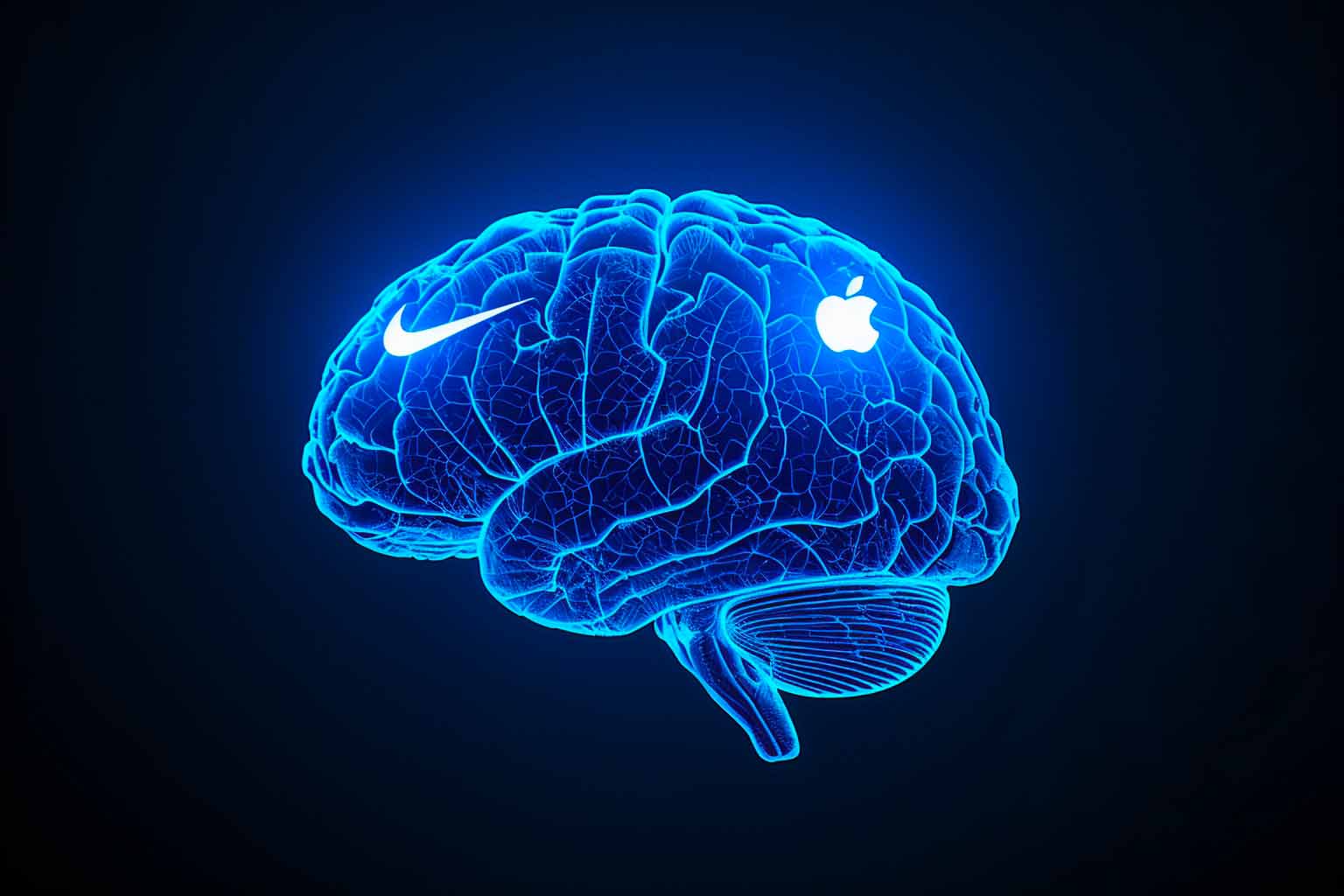
The invisible power of brands
Coca-Cola is just a soda. Tylenol is just a medicine. Levi's is just jeans.
Yet millions of consumers pay more for these products.
Why? Because our brains don't just consume objects,
they consume stories .
A Duke University study showed that people exposed to the Apple performed better on creative tasks than those exposed to the IBM .
Apple has successfully associated its image with creativity, freedom, and a cool attitude.
This subtle conditioning works even when we aren't consciously seeing the logo.
Brands shape our identity
Every brand choice is also a choice of identity.
When you wear a Nike cap, you say something about yourself.
Nike represents performance, victory.
Under Armour, on the other hand, symbolizes the spirit of the underdog, the fighter.
Choosing a brand means aligning with a personal narrative :
one that corresponds to what we want to be — or what we want others to perceive.
When the brain becomes attached to a brand
Neuroscience confirms this emotional dimension.
Professor Michael Platt (University of Pennsylvania) observed the brains of iPhone and Samsung users.
The results are surprising:
Apple users activated the same brain areas linked to familial empathy when they heard about Apple.
In other words, their brains reacted as if it were a close relative.
Conversely, Samsung users didn't show a positive or negative reaction to their brand—but rather the opposite response to Apple's bad news.
Their pleasure stemmed from their rival's misfortune.
This demonstrates that Apple didn't just create a customer base; it created a tribe.
Brands as social substitutes
This almost emotional connection shows how much brands today fulfill functions that were once reserved for communities, religion, or family.
We live in an era where logos are replacing coats of arms.
Brands are becoming markers of identity , pillars of meaning and belonging.
Take back control
The first step towards freedom of choice is awareness .
Before buying, ask yourself:
"Why do I want this product?"
- Is this really a rational preference?
- Or is it a form of self-expression?
- Is it the need for the product… or the need for belonging?
We cannot escape brands — they are part of our social world.
But we can choose to understand them instead of simply consuming them.
Conclusion
Major brands like Apple or Nike don't sell objects, they sell identities .
They infiltrate our desires, our values, and our deepest emotions.
Recognizing this power is already the first step towards freeing yourself from it.
Because deep down, your brain has no brand—unless you give it one.